Showing posts with label Cardassian Occupation of Bajor. Show all posts

Saturday, 2 April 2011

Deep Space Nine Review. "Progress" 1x14

"When I first met you Major, I thought you were hostile and arrogant. But I was wrong. Bajor needs you. I need you. I like you, and I don't want you to be hurt

(But I still want you to give the old duffer his marching orders anyway!)"


Sisko and Kira have a good ole Trek heart to heart. (And indeed have something nice to say about each other for once in the first season!)


This drug cake. Will my Shatners bassoon really make me think a second lasts a month?


Synopsis


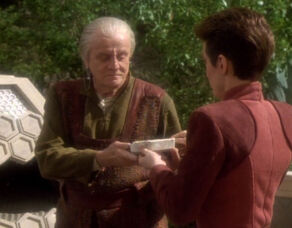
The provisional government hands a intransigent Anthony Hopkins lookalike his eviction notice, in order to render a habitable moon he lives on - to waste, in order to tap its power. Obviously the proverb of selling the cow for a handful of beans doesn't translate well in this neck of the woods! Oh and Kira gets all emotional (again.)


Review


I'm a tolerant chap vis a vis poetic licence on the telly. I don't write angry e-mails to George Lucas effusing that are we expected to believe that the Death Star laser, that can blow a planet up in a millisecond; won't harm a man stood two feet away from it, just because he is shielding his face with his hands. I don't really subscribe to the notion that ultra scientific accuracy should trump, or even be at the expense of entertainment for a soft sci-fi show or film. However there are occasions when something is so strikingly silly, it does affect the viewing experience (but not in this case the viewer enjoyment.). The plot of this episode revolves around a moon (called Jerrado) of Bajor that is going to have its core tapped to generate much needed power on Bajors surface. Firstly how are they going to transfer this power to Bajor to utilise it? Geothermal energy from the hot interior of a world is a feasible source of power, but you tend to have to be on the same bloody planet to feel the benefits! Are they going to build a huge pipe to transport the energy or something? Secondly the moon is inhabitable. This brings up two issues. Why has everybody just ignored this place? Kira says only a measly 47 Bajorans lived there at all. Bajor is said to be on its ecological arse after the occupation. Why are the Bajorans not queuing to settle the fertile virgin lands of Jerrado? The Bajorans have had spaceflight for a couple of centuries, why did they not settle it beforehand (If our moon was a class M planet, I guarantee it would at least have a manned science outpost, and most likely a colony too and we've only been in space a few decades.) Why did the Cardassians not make use of Jerrado as well? Mullibok implies he sat the occupation out up here. As I said this doesn't really temper my enjoyment of this episode, but it is a big oversight on the part of the writers. Perhaps if Mullibok had lived like an asteroid hermit off the game "Elite" that was made of unobtanium the Bajorans needed, and they were going to grind up for energy, then it would have made more logical sense in that regard. Never mind though, and on with the review.


As we said before the Bajorans are going to extract energy from the core of Jerrado, and this will render the moon uninhabitable. Kira and Dax are doing one last orbital survey to make sure the moon has been totally vacated before drilling starts. They discover 3 people who aren't part of the survey team, upon beaming down Kira is surrounded by two pitchfork wielding yokels outside of a cottage on the surface. The owner of the cottage; a farmer called Mullibok (who looks uncannily like Anthony Hopkins, but not from Wales though) - tells his friends to stand down. Kira tells him he has to leave as they will all be killed by the core being tapped, but he refuses saying he had enough shit of Cardassian bullies, let alone Bajoran ones. Kira tries pithy good cop tactics to win him over to her side (which shows us a new side of Kiras personality.), but Mullibok counters by using stalling tactics by inviting her in for a supper that will take hours to actually prepare. He spins tall tales about his past and says he has lived on Jerrado for 40 years and will die if he is forced to leave his home. He tries to bait Kira into storming off by patronising her with sexist comments , but in a nice scene, she twigs on to what he is doing before almost falling for it.


Kira decides to try to convince the minister in charge of the operation to postpone it so she can convince Mullibok to vacate Jerrado, but he refuses and says that he wont put off for three people, and if Mullibok won't leave of his violation, he'll have them beamed up without their concent. Kira realises that this tactic will likely do the old geezer in, so she decides to lead an armed team to perform a forced eviction. It predictably goes tits up after about three seconds, and Mullibok goes mental at the guards which gets him shot in the process.


Kira who had (surprise surprise) got emotionally involved with the charismatic farmers plight, disobeys orders (surprise surprise) and offers to nurse him back to health. She tells him about an old ugly tree that used to stand near where she lived as a kid. That she hated that tree for it being a big bastard that blocked all the sunlight and sucked all the nutrients away with its gnarled roots. But she couldn't bring herself to chop the thing down for some reason. It is sort of a metaphor for Mullibok too, and for Kira's (and ours) view of his plight. His behaviour is on some level self centred. He claims no to care that his intransigence will mean lots of his people will do with out. And even that he sat out the occupation on Jerrado and turned his back on his race. But despite all that, and down to Brien Keith's brilliant protrayal of him, we still feel some sympathy for his plight. That the needs of the many may outweigh the needs of the few, but it may not always feel like that if you are emotionally invested to the few who are on the receiving end. Sisko himself now turns up on Jerrado. He says that she won't be sacked for what she has done. This is really a turning point for the Kira and Sisko relationship. They were essentially adversarial at the beginning. In "Past Prologue" he threatened she was through if she ever went behind his back ever agin. But here he confesses that he was wrong about his initial assessment of her (see the quote above) her, and that Bajor needs people like her. That she is on the other side now, and can't just always instinctively side with the underdog in every single issue. She must fight for Bajor in other ways, ways she may not like. She has a job to do here, and she must do it.


It is brought up of course, that the forced relocation is really no different to how the Cardassians behaved during the occupation. This is not really the case. The relocation is unpleasant for the ones being moved (as it is for anything like this.), and there ain't any getting away from the fact that an old man is being made homeless, and that is by definition a horrible thing to have to do. But Kira's and the Bajorans first response to Mullibok was to persuade him to move personally. That he would be recompensed for the move. they could have beamed him up when he was knocked out during the fight, but they didn't. Kira used force only as a last resort. The Cardassians used force as a matter of principle. If they had wanted to vacate Jerrado for this purpose, they would have gone down there and shot the three of them as soon as they resisted. They may possibly have shoved them all into a labour camp. They certainly wouldn't have offered to nurse him back to health, and have used metaphors about gnarled trees.


Mullibok still won't budge and says everything he has is on this moon and that he will go with it. Kira realises that he means what he says, that he wail not leave whilst the cottage is standing. So she will have to bring it down herself. She takes a lit splint from the kiln he has finished building and torches the cottages. He now has nothing to stay for anymore. He has no option but to silently beam up with Kira, spurning her attempt at a reconcilliation.


Before I finish the review there was a B plot in this episode, about Jake and Nog buying some self sealing stem bolts (we never find out what they do, which becomes a running gag.) and trading them for land as the Noh-Jay consortium. It is hard to see any greater point this stuff is supposed to be about than providing filler showing the friendship of these two. But it is a case of one of those B plots that has nothing to do with the A plot, and actually being diametrically opposite in tempo to the main plot (this is a light hearted subplot to a serious main one.), which gives the whole episode an odd and clashing momentum at times.


Mistakes and Questions


Jerrado is the fifth moon of Bajor. Didn't Jake say that Bajor had three moons in "The Nagus"


Dax says that she thinks Morns facial hair makes him cute, and that she entertained going out on a date with him. I thought Trills were above such petty things as romance and relationships? You said it yourself love!


Mullibok says he was the first person to settle here (admittedly the tales of his past antics seem distinctly tall ones at that!) on Jerrado. Again, why did everyone ignore this moon. Did the prophets say it was out of bounds or something?


Kira tells her two armed guards that the trio don't react well to uniformed; armed soldiers. So it makes sense she walks into a tense situation with two conspicuously uniformed and armed soldiers. A bit of subtlety next time?!


Bashir says that Mullibok should be transported to DS9 when he is wounded by the shooting. I may not be 100% accurate, but isn't Bajor itself closer [to Jerrado] if you need to get someone urgent treatment?


Betty's Thought for the Day


The transmitted version of "Progress" diverged from the original intent of Peter Allan Fields (the writer) script. Allan Fields wanted Mullibok to be a less sympathetic and more ruthless character than the way he was performed by Brian Keith. Keith is extremely charismatic and likeable in the role. The original intention was to emphasise that Mulliboks seeming affection for Kira was purely superficial. That when he calls her by her first name he was blatantly trying to manipulate her, that he knew she was so easy to emotionally lead by the nose. The scenes where Mullibok seems pretty indifferent about Bajors plight, and the implication he shirked the occupation on his moon are perhaps left in remnants of this darker vision of how the character himself was originally conceived; that were transmitted in the final product. It is hard to say whether this portrayal would have altered the episode for the better (it would have made Kiras actions less ambiguous I suppose.). But Allan Fields desire to break a stereotype (the telly curmudgeonly old dude is really a sweet guy once you get to know him) is indicative of the DS9 writers willingness to shake the rules up in a way the later shows wouldn't.


Summary


Progress would seem at first glance to be rather a quiet episode. It is certainly short on things like action. But the episode does mark another turning point in Kiras character growth, where yet again she has to (admittedly not entirely successfully) suppress her instinctive desire to side with the underdog in order to fulfil her new and broader responsibilities to her people (however much she isn't comfortable with it), and a step away from being at loggerheads with Sisko and them both evolving a more amicable relationship with each other. The episode is a strong character peice (Keith, Brooks and Visitor all put in sparkling performances) with a nice bit of soul searching that doesn't veer into saccharine schmuck. If the episode has a flaw, it is the B plot that doesn't compliment the A one at all, and actually contrasts badly with it in its tone, which gives the episode some very odd pacing at times. But apart from that this is good stuff.


Rating 8 / 10


Next Time If wishes were horses..... I'd rather be reviewing an episode like "The Visitor" probably
Friday, 25 February 2011

Deep Space Nine Review. "Babel" 1x04

"Oh! I see."

Odo response to virus sufferer


Whoever says we never do culture on this blog!


Synopsis.


A mysterious virus on DS9 causes those afflicted to start spouting incoherent gibberish that makes people think they are insane, and then they die. a bit like watching too much Fox News then. (apart from the dying bit of course.)


Review.


Babel starts off with an extremely flustered and overworked O'Brien trying to fix the many, many things that keep breaking down on DS9. He is interrupted by Captain Jaheel, some alien dude who has a cargo ship and makeup that isn't really going to win any design awards for Paramount. Jaheel bitches about how he can't be delayed anymore as his cargo will start rotting. Jaheel is one of those whiny customers, anyone in the service trade hates having to deal with and on a bad day; would love to punch them in the smug face. You know - one of those who has to give their bitching; passive aggressive tuppenceworth about how crap you are at your job, like they'd do any fricking better BTW, under bad circumstances!! (Not that I'm projecting ill will to this guy because I've ever had bad experiences in a customer service based job you understand!! (-;) The chief eventually finds time for a cuppa at the replicator terminal he is fixing, which has a hidden device attached to it which must be evil because they play that "sinister" incidental music just before the opening credits roll.

"Don't laugh at my makeup asshole! The Ugnaughts off Empire Strikes Back think I'm their God!"

O'Brien suddenly starts spouting meaningless gibberish (and I ain't talking about technobabble), and cannot even write coherently either. Bashir diagnoses that the chief is suffering from aphasia, where the brain can't process words properly. But he can't detect brain damage or cranial trauma. Meaney conveys the mixture of fear and frustration that an aphasia sufferer must go through at being struck down by such a surreal and frightening condition - really well in those infirmary scenes. It gets worse. Jadzia gets struck down with it. Bashir discovers it is a synaptic virus that screws about with the brain, hence why they are spouting gibberish (and hence where the title of the episode comes from).


As more people are struck down with apahasia, the station erects a quarantine. Quark; who due to the almost stationwide replicator failure - couldn't trade, has found some way to circumvent this and allow his bar to stay open. Odo doesn't believe his cover story that Rom fixed the bars replicator, as Rom couldn't fix a bent straw*. Jaheel proves himself to be a bit of a pussy, and asks Sisko to break the quarantine for him, as he doesn't want to get sick. Sisko refuses, and then learns Jake has been struck down too.


Quark has managed to bypass the replicator problem by breaking into affected crewmembers quarters, and using the only working replicators on the station to stock his bar (must bring in long waiting delays.). This is a bit of a bummer as Bashir discovers the virus is foodbourne. Quark has unwittingly spread the virus far and wide. If this wasn't bad enough it has mutated to an airbourne virus as well! The virus is man made, but not a Cardassian one, but planted by the resistance when the station was built 18 years ago. Oh and there is the minor thing that those who are afflicted die after about 12 hours of contracting it. There is quite a nice scene in the infirmary when Bashir says that although the virus is so destructive and will likely kill them all, he would like to shake the hand of the man who designed something so clever. It reminds me of a line in the novelisation of "A New Hope", when one of the rebel pilots in a moment of grim irony, despite knowing how deadly the Death star was, and the evil it represented - couldn't help but be blown over by how fricking awesomely clever the whole contraption was. Bashir's comments are realistic. It may be badass, but it's badass with style.


It's more bad news as Kira discovers that the geneticist / resistance fighter who designed it (and hopefully the antidote) is no longer alive. But she discovers his assistant Surmak Ren, who cuts the call off when she mentions the virus. Bashir contracts the virus without discovering a cure himself. Jaheel meanwhile attempts to break the quarantine, but only manages to wreck a docking clamp and sever the fuel lines on his ship in the attempt, which means the ship will explode in a manner of minutes (according to the physical principles of when the script tells it to.). Kira manages to beam Ren up (so she doesn't break quarantine) in a runabout telling him he has to find a cure, as she is infected, and thus he is now too. Sisko contracts the virus leaving only Odo and Quark (at a fee) to set the ship free before it blows the station as well. Of course they manage it (we get some poor model work fx as well, which don't stand up well with the Babylon 5 CGI that would come a year or two later.), and of course Ren comes up with a cure, and everyone is saved (God he must have been a very observant and diligent assistant when the virus was tailor made!). And we get an obligatory "who'd be me" end scene where Sisko awkwardly bollocks O'Brien for his dodgy tea from a faulty replicator, as we have to end on a light note ho ho!


Mistakes and Questions.


*Odo says Rom is to thick to mend a bent straw. Which contradicts the aptitude Rom would show in fixing stuff later on down the line. I suppose this isn't really a mistake as it is only Odo'd opinion. And sometimes appearances can be deceiving.


O'Brien mouths off about being put upon in ops, after Sisko asks him to fix a replicator. Hang on! I know he's having a bad day, but this is his CO he is talking to. Perhaps Sisko took pity on him.


Quark is seen pestering patients he thinks are faking the virus to get out of paying their bar bills, in the makeshift ward. He's making a lot of noise, and harassing ill people. Shouldn't someone like Sisko or Bashir ask him to leave?


Who was guarding the docking bays so no-one attempts to breach the quarantine? Jaheel seems to have boarded his ship without anyone stopping him, and no-one is down there except for Odo at the end. Was there no security well enough to enforce the quarantine. And how could they have even enforced it anyway, if there are no security men free?


Isn't it a bit strange that this virus affects Bajorans (as well as humans and other species) as well as the Cardassians it was intended for? I mean if this virus is as clever as they make out, why not bioengineer it for Cardassians only? What would have happened if it had been passed on to Bajor itself?


Betty's Thought for the Day


The episode is named after the Babel parable in the Bible, and it does have some interesting parallels with the episode itself. If you don't know the story I'll sum it up. The people of Babel were the first survivors of the Noah flood, and had built quite a nice little society for themselves, and it was the first instance of humanity being totally unified in culture and language. They started to build a tower partly designed as a beacon of their new society should things go tits up, and partly out of hubris. To build a tower to reach the heavens themselves. God wasn't to happy about mankind getting ideas above its station and he smashed it up and scattered the human race all over the earth, and the unity of language and culture was severed forever. The interesting thing for me is that story can have two different meanings (or better still, morals of the story) depending on your world view. I think it is fair to say the conservative commentator Peter Hitchens summed it up nicely as those who see man as inherently sinful, and that these Utopian grand schemes, where mankind presumes to know better than the higher authority, always end badly. Thus God was intervening to put mankind in its rightful place. The other school see man as essentially good and even capable of being perfected somewhat. That this was a spiteful act by a jealous god determined to stunt his ambitious children, and to bring mankind down and divided, and easier to rule over. The story and the symbolism about it was the basis of the backstory to Babylon 5 (the station is a future version of the tower, and the Shadows try to do what God does in this story.) However this story is sort of a loose inverted version of the Babel myth. On here the "superior beings" built their tower (Terok Nor) to stake claim over the "lesser beings", and to reach down to the land (it was a mining station). And it is the vengeful "lesser beings" who try to tear down the tower, and "confound the language" of the "superior beings." Intentional, or am I just reading too much into it. I just though it was an interesting take.


Summary.


Babel may be the virus of the week story, and hardly original, but for a story of this nature it was a pretty good one. For an early episode it is an unusual example of an ensemble piece, with all the regulars getting something to do. It is well paced, with Quarks B plot tying into the main plot, and the level of danger increases incrementally throughout so the sense of threat feels present and a genuine race against time. The only downsides are the poor "ship blows up" scene and how quickly everything has to be resolved, and how easily the virus is cured at the end. But that is a symptom of how much they put into your average DS9 episode. All in all a well established and entertaining episode with some good scenes and sense of pace (until the end). A nice standalone well worth watching if you have 45 minutes to kill.


Rating 7 / 10


Next Time


O'Brien befriends an alien from the Gamma Quadrant who appears to be on the run. And the Prime Directive is invoked, which is a handy get out of jail card for dealing with awkward moral issues.

Friday, 18 February 2011

DS9 Review: "Past Prologue" 1x02


"It's just Garak. Plain Simple Garak!"


Yeah right.


"Tell that kindly old lady down the street, we have discovered a permanent solution for stopping Tiddles shitting in my garden, right here in this satchel!"

Synopsis


Kira has divided loyalties over a former resistance fighter wanted by the Cardassians. And the beginning of possibly the greatest mystery ever to grace the Star Trek mythos. Just what side is Garak batting for?


The teaser of Past Prologue starts off by introducing us to Garak. The only Cardassian who stayed behind on DS9 after the withdrawal. The show would tease us throughout over why he remained. He claims that he is just a simple tailor (though no-one believes him) and nothing more. But as we go on we learn a little more (but never quite why) about why he has remained, which we will look into in later episodes. He strikes up conversation with Bashir; who thinks (like everyone else) he is a spy who has stayed behind as the eyes and ears of Cardassia. He dismisses that with the line I have quoted above. It is clear from the way Andy Robinson portrays him that we are not to take this at face value. Garak clearly loves the mystery and suspicion that surrounds him like a shawl and plays up to it beautifully. Bashir is weirded out by it and leaves convinced he is trying to recruit him into his spy ring. It really is a great scene with plenty of laughs. It is little wonder Garak became as popular as he did.


Meanwhile in ops, a Cardassian warship fires on a Bajoran transport and destroys it, but they are able to beam the pilot to safety. The Bajoran man is able to let out a pathos laden "help me out" speech before passing out from his injuries, which is of course a cardinal rule of telly. It turns out the guy is a former fellow freedom fighter of Kira's. (this is a DS9 stable. Kira seems to know just about every guest star of the week as either a former resistance member / collaborator / black market; arms trader, who managed at one time to make her acquaintance. I wouldn't be surprised if Kira could enter a McDonalds in Fiji and recognise the burger flipper as a former member of her cell.) Tahna Las; disturbingly is also a member of the Kohn Ma. The Kohn Ma is sort of on the Al Quieda end of "freedom fighters". They continue to attack Cardassian targets and civilian ones at that. They have murdered Bajorans they didn't like, and are generally not very nice. They have been disowned and banished by the provisional government, but Tahna requests asylum on the basis that his Cardassian pursuers are going to resort to much more than strongly worded questioning if they get hold of him. Sisko is skeptical, for one thing the Kohn Ma continue their attacks on the Cardassians, and because he doesn't entirely believe that Tahna is sincere about cutting his ties with his organisation (and the episode gives the impression we are right to think he hasn't cut ties.). Kira however is keen to bend over backwards to get him asylum. He is after all a fellow freedom fighter, which she believes Bajor needs more of. After going over Sisko's head and appealing to Admiral Schoolmarm, Sisko bollocks her with this cut down remark.


"Go over my head again, and I'll have yours on a platter!"


Presumably accompanied with crinkle cut chips, what with the nose and all that. Ironic cannibalism.


The conflict between these two isn't really the crux of the episode. The actual moral dilemma lies within Kira herself. Kira still has a pretty rose tinted view of the occupation. It was evil Cardies versus the plucky Bajoran underground. That was the world she grew up in. However Kira is beginning to see that Bajor (or at the least herself) is going to have to think bigger picture despite whether she wants to or not, lest her world goes under. Although Kira would ideally have the Federation bugger off tomorrow, and that the wormhole may bring problems. she knows that Bajor is on it's arse, and that her people need to rebuild and try to take advantage of the situation. Tahna (who has been granted asylum as he is on pain of torture if captured.) on the other hand says Bajor should tell the entire galaxy to fuck itself. Bajor should look after itself and everyone else can take a running jump. This is where we see that this is an episode as much about a conflict of ideas, as a conflict between individuals.

"Nice to see Andy Robinson doing his little bit to quell superfluous rumours!"


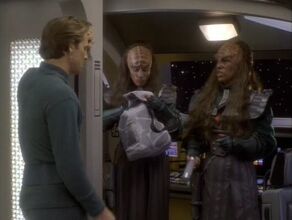
We see the begining of Garaks friendship with Dr. Bashir in this episode. Now as anyone who knows anything about Star Trek knows that there is some online speculation amongst some fans that Garak is gay, and that he and Bashir are more than friends. I don't want to comment much more on this, firstly because it is really irrelevant to the characters in the context of the show and their character arcs. Secondly because it is a bit silly, and thirdly because it is amongst the least interesting background questions we could ask about this multi layered and fascinatingly enigmatic character. Garak has spotted the Duras sisters, who apart from their secondary mission to draw in TNG viewers; are covertly meeting with the Duras sisters. Now I don't object to this as some kind of stunt to get more viewers (this is TV folks they do this stuff.). And surprisingly their presence makes sense in the context of the plot, not just some daft attempt to crudely shoehorn a popular character into a story that doesn't justify their presence, apart from some gratuitous figure boosting stunt. Garak is able to trick the sisters into thinking he is a proper Cardassian spy spy, rather than being a possible Cardassian spy. they tell him about the bomb they are selling him, and offer to betray him to the Cardassians after they sell him the goods. Julian who is hiding in the changing room of the tailors can then pass this third person information on to Sisko, where they decide to let Tahna think he can pull his bombing mission off, and lie in wait to capture him before he completes it.


We really get to the heart of the issues of this episode in the scene with Odo and Kira. Kira is in a bad situation. Her complicity in allowing Tahna and his accomplices to gain asylum. Her bending over backwards to vouch for a guy who turns out to be a sort of space Bin Laden. And it was all for nothing. He used her naivete around the motives of all "freedom fighters" to pull of more attacks. She says that although life in the resistance was seven shades of awful, the simplicity and black and white nature of her world back then was somehow appealing. (Odo himself when proposing chucking the Duras sisters in jail without charge -mused that while Cardassian rule was tough in comparison to the bureaucratic, compromising fudge of Federation procedure - it was at least simple.) Kira is now confronted with a world that is more ambiguous and with more grey areas. She no longer knows what being patriotic to her people actually entails. Odo implies that the changing nature of society means that these values also change, and that it the crux of the difference between Kira and Tahna. Kira joined the resistance out of necessity. She saw that the Cardassians were beating and violating and working her people to death in the labour camps, and that no-one in the galaxy seemed to give a shit. That she would have to take up arms in a guerrilla war to drive the Cardassians offworld. If Kira hadn't faced the Cardassian occupation, I doubt she would even have fired a phaser in her life. she joined to free her people. Not for herself. That sounds like a moral decision based on patriotism to me. Tahna on the other hand fights because he enjoys killing and violence. He fights because he wants to impose his values on everyone else, and you can stare down the end of his gun if you disagree. Tahna fights for himself because it's what makes his dark heart pound with glee. That is why Kira makes amends for "helping" this man, and why she "betrays" him. Because she does what she thinks is right for her people. Something Tahna would never do.


She accompanies him on their mission, ostensibly as a sympathiser. He reveals he plans to collapse the wormhole so Bajor loses it's real estate status. He claims the Cardassians and the Federation will leave the world alone after this. I thought hang on! The Cardassians possibly. After they were driven off would they risk another conflict for a tapped out world without the wormhole? But the Federation was making overtures to the Bajorans before the wormhole was discovered. After all that effort channeled into Bajor are they just going to pack up and leave when the wormhole was capped? She sabotages the mission and Tahna subdues her. He forces her to set course for the wormhole, or he drops the bomb on the Bajoran colony they met the Klingons at. Kira manages to fly the ship into the Gamma quadrant, where Tahna in a fit of rage fires the bomb and misses the wormhole. They fly back and Tahna chooses surrender to the Federation rather than being given to the Cardassians. Kira tries to reason with him as he is led away to a cell, but he hisses "traitor" at her and is marched off. It was too bad Kira doesn't respond, but if she had; she should have said.


"You call me a traitor. You who lied to me and took advantage of my goodwill to someone who I thought fought for the Bajorans. You who I stuck my neck out, and nearly got my ass busted for, and all you did was belittle what I did for you. You who were willing to reduce our strip mined planet to some impoverished isolated backwater just so it could be "pure". You who would kill millions of innocent Bajorans on the colony purely out of spite. And you who went running to the hated Federation, when you realised you're ball sack may be slowly removed with rusty pliers in a Cardassian jail cell.


And you call me a traitor!"


Mistakes & Questions:


Odo claims he doesn't do pretence. Aside from the fact that the ability to use pretence would be valuable for a security officer who has to undertake questioning of suspects etc. Odo actually does resort to pretence. One example is him (well he is sarcastic when he does it) interrogating the Flaxian assassin in "Improbable Cause" in season 3.


Odo also claims that some ostrich from a made up alien planet sticks its head in water and eventually drowns itself, when it is frightened. This is of course a variation on the myth about ostriches sticking their head in the sand. It makes no sense from an evolutionary sense for an ostrich to inherit such as stupid trait.


Bettys Thought for the Day


The character of Garak was a real boost to the show. There is so much potential in this mysterious guy who remained on board after his people left, for reasons we can't quite fathom, and almost certainly is not there for any legitimate reason. The writers wanted to come up with a way to use him again, and I must say casting the brilliant Andrew Robinson alone made him a shoo in for a return visit.


Summary


Past Prologue is a strong episode, bringing in new layers of subtext to the show such as how a post occupation Bajor should continue, to the increased moral greying of the ocupation itself. There is a strong sense of multi layered character conflict and conflicts of interests going on in this episode, as well as an increased sense of having to do backroom deals and breaking the rules which brings the show apart from its Starfleet run starship based prediecessor. Garak is a great addition too. Such an enigmatic character. We never know why he "helped" uncover the plot, was it purely a self interested act on his behalf or an attempt to help DS9, or both? Looking back it is astounding how much they crammed into DS9 episodes at times. This episode sets up plenty of interesting stuff for the future and never loses pace, so a good continuation from the pilot.


Rating 7 / 10.


Next Time.


"A Man Alone" The charming tale of a bad man who comes up with an implausably complicated plot to smear his enemy. Keiko gripes about some stuff. Rom's personality is at odds from what was seen in later episodes, just like Baldrick in the first Blackadder series, and Count Dooku shows up standing in the background looking a bit evil. I kid ye not.

Monday, 14 February 2011

DS9 Review: "Emissary" 1x01


"No! It is not linear."

"This pre season 4 northern migration of your hair. What is this?"


Synopsis.


The Federation assists a strife torn world on the frontier of the universe (about 90 light years from Earth if that Star Trek star chart book is to be taken at face value.) devastated by decades of alien occupation, and they discover something that could change the face of the universe for ever (and I ain't talking about broadband; internal combustion or Justin Beiber.)


Review.


This is the pilot episode of Deep Space Nine, so for a kicker we need to have some scenes to provide back story for who the main protagonist is, and so we relive the fateful battle of Wolf 359, (3 years earlier in story chronology. None of the battle was actually seen in the episode originally showing the events leading to it. I presume they ran out of both cash and time.) which was Starfleets final stand against the Borg invasion. I say battle, it was a massacre, all those 39 ships were destroyed and the Borg were stopped only by an eleventh hour fluke. Well watch the "Best of Both Worlds" for more detail on that. Back to this story however, we see Ben Sisko an officer on the USS Saratoga glaring at Locutus (an assimilated Captain Picard from "The Next Generation") on the viewscreen as Locutus informs them of their impending doom. The Saratoga gets smashed up in about nine seconds and with the call to abandon ship Sisko attempts to rescue his wife and son from their burning; collapsed quarters. Now this raises a question for me. Why were civilians on this ship at all? In "Both Worlds" Admiral "God off Star Trek V" Hanson said the stand at Wolf was actually planned and not just some last ditch attempt to save Earth, so it's not like the Saratoga wasn't just rushed into a desperate last stand. Why then were the civilians not all evacuated to a starbase or something? Sisko manages to save [his boy] Jake, but his wife Jennifer has been crushed to death by falling debris. He is forced to leave her body (Brooks excellently portrays just how awful a fate that must be for a loved one to be put in) in the wrecked ship as he watches the ship get blown to bits. He now has nothing left of his wife, not even a memorial spot to place a flower. Tragic. Avery Brooks is a very talented physical actor, and his face says a zillion times more than any dialogue would when he watches the Saratoga blow.


Three years later Sisko and Jake are en route to his new assignment, and thank god that; unlike many Trek protagonists, Jake and Ben get on well as father and son. This Oedipus thing was one of the less desirable tropes of Trek, but more on this in a later review. It was truly too bad they never really capitalised on the Jake / Ben relation more than they did. Jake was an earlier Travis off Enterprise for being overlooked by the writers. As I said Ben is to be the chief administrative CO on Deep Space Nine, a grotty looking station orbiting the recently liberated and strife torn world of Bajor. Being captain of the Enterprise it aint. Sisko clearly doesn't want the job, and Jake points out that it sounds like the shittest place in the universe to be a teenage kid. Sisko has to lie and point out the tenuous benefits of living on DS9. This scene is a bit like a Dad bullshitting the line to his kids that a caravanning holiday in the former Soviet Union is as equally exciting a vacation as a fortnight at Disneyworld. "Hey son, Space Mountain isn't even real. Baikonar has real rockets! They even have grazing reindeer on the Steppe! And we all know who uses reindeer don't we!" Hypothetical Dad isn't selling it and Sisko isn't either.


Deep Space Nine, a former Cardassian mining station in orbit of Bajor (which make sense, as there is a shitload of ore in the vacuum of space.) is the ugliest thing ever. A postmodernist hat stand. It looks like a steampunk airport cum service station inside. I never took to the look of the station, for one thing I like the more realistic look of Babylon 5, which seems more plausible for a space station design. The place has been trashed as a good bye present by the retreating Cardassian occupying forces. It's a mess, and a ghost town in the making. Chief O'Brien, an engineer from the Enterprise D assigned to the station as Chief of Operations and Major Kira Nerys, a highly strung and vocal Bajoran national (mmm. Sounds like Ro Laren? Should do. Michelle Forbes was supposed to take this role but declined. That is ironically why the writers set the show on Bajor.) compounds the pessimism of their state. The planet is in a dreadful state after 40 to 60 years (depends on who wrote the script). It's mined out, trashed (though it looks surprisingly green and healthy. Should it not resemble the Narn homeworld a bit more?) and the new provisional government is weak and divided, and riven with hostile factions. The planet will likely end up with a civil war in the near future. They then see local lawman Odo (nicknamed constable, after his love of English romantic painters), whose made of the gunge stuff inside Jaffa cakes - nab some alien weirdo and a Ferengi boy for looting. Sisko spots a chance to stop the exodus of vendors when he discovers the boy is the nephew of the owner of the bar, Quark. He'll get Nog (the boy) out of a prison sentence if he stays and becomes a "community leader", Kira points out this is unwise as Quark is about as trustworthy as Bernie Madoff.


"Look, it's an Frenchmans God given right to drink Earl Grey in front of a backdrop of an unrealistic looking planet!"


The next scene is a controversial one amongst fans. Sisko meets Picard, and it ends up in a heated confrontation. It is a classic case of a good bad idea. Sisko holds animosity towards Picard as he believes that Picard as Locutus is responsible for Jennifers death. Now this is not a bad call because it is unrealistic (it isn't). Nor was it badly acted (the opposite) or even a lousy scene (it wasn't). It doesn't work because we side with Picard, not our protagonist. Which is a bit of a bummer if we are supposed to like him. Unlike Sisko we are privy about Picards direct role in the affair, how he was consumed by guilt. How it came close to breaking him. We can understand Siskos anger, but not condone it. Here was this guy who was well liked on the predecessor show, who went through hell over the Borg thing, and this unknown guy is being like this. That is why, perhaps looking good on paper -it was a bad call.

Sisko chews the fat with Kira, who tells him that she sees the Federation as little better than the Cardassians and rather ironically from an Earth point of view - that it is the Bajoran religion that can really unite her people. The Kai (a kind of Bajoran pope) is a recluse and sees no-one, but she has the power - to quote HeMan -to unify her warring flock. Obi Wan Kenobi than shows up and starts acting in an ethereal intense manner that fictional religious folk seem to do on telly. Seems Kai Opaka wants an audience with Sisko, she takes his pagh ( a Bajoran version of the force), which unlike taking his temperature or his tax return details involves grabbing someones ear. I believe the original idea was for a Bajoran to tickle a persons toes or something. She says he will be the emissary to the prophets, Bajors gods, who live in the celestial temple (which sounds like a Vegas casino) and send orbs (or tears of the prophets) to guide the Bajorans, all but one of which was pinched by the Cardasssians during the occupation. Sisko looks at the orb and has a flashback to when he met Jennifer by kicking sand in her face on a beach. Sisko is euphoric and starts acting like a lovestruck kid, but Jennifer (Felicia M Bell pulls this off very well) initially just thinks he's a weirdo (in her eyes he's still just a stranger), but is won over by Sisko who is surprisingly a bit of a ladies man. The vision ends and the Kai implores Sisko to discover the location of the celestial temple before the Cardassians figure it out.


Jadzia Dax and Julian Bashir arrive now, the former is a 28 year old women who has a 300 year old slug in her (no really) and Dr Bashir who is a cocksure and green newly qualified starfleet doctor. He tries (and fails) to get a date with Jadzia (this'll be a running thing over the years). Sisko says he has to put her [Dax] to work, which just sounds like he's her pimp. No to work in locating this celestial temple to shut that barmy pope lady up. We discover Dax and Sisko are old buddies, but that was when the Dax slug had a male body (Curzon). Now he has to accept his old friend can now be eligible to model knickers in a John Lewis catalogue. Bashir however puts his foot in it with Kira, when he patronisingly describes how Starfleets finest new doctor passed up all the good shit to be assigned to Bajor as it is a frontier wilderness. Kiras putdown over his human chauvinism is one of the many incidences of DS9 overturning some of the "excesses" of the previous shows.


Dax discovers the location of the celestial temple, and again I have to ask. How has it remained undiscovered for so long? This is the Bajoran equivalent of finding the pearly gates for heavens sake! (no pun intended) They should have pulled out all the stops to find it. Dax says that there are numerous incidents around an area of ionic interference. Anecdotes from 200 years ago (so Bajor has had spaceflight for a while) about the heavens opening in that location. Why didn't the Cardies (who seem keen to hoard the orbs) send some of their ships to scan the area with a fine toothed comb? Now call me silly, but concentrate the search and try focusing on that area, you may be onto something. If on Earth we had a legend about a god hole to heaven, and that people in London had reported seeing a big god hand around Tottenham Court Road, a London bus ended up driving on clouds when it was just on the North Circular, and a beefeater reported seeing an angel come out of a grid in Wapping, you could imagine the religious authorities would be all over the Greater London Area, and they'd have likely have found it.


Gul Dukat (more about him in later reviews), the former Cardassian military governer (or prefect) of the Bajor makes his first appearence about now. Dukat would become one of the most popular characters on the show. It is hard to imagine now that Marc Alaimo was actually not originally cast for the role, but the guy who was didn't end up taking the role. It just wouldn't have be the same show! Dukat implies that he wants his old job and station back and reminds Sisko that Starfleet is a long way away. All delivered with that well mannered villainy he will become to be famous for.


They need a way to get Dukat's ship off their backs so Odo sneaks on board by shapeshifting as a sack (wouldn't we all?) disables the sensors and Dax and Sisko do what someone should have done umpteen years ago discover the celestial temple, in fact an artificial wormhole to the distant Gamma Quadrant on the other side of the galaxy. It is the only stable wormhole ever discovered. Coming back to Bajor they get stranded on a "planet" where an orb zaps them both and Dax gets sent back to DS9, Sisko makes contact with the beings who built the thing. As it is in the eons old superbeings guide to etiquette, they of course speak in a vague and cryptic manner. Did no one in the olden days in space ever get the concept of getting straight to the fucking point? They do not exist in linear time as we do, experiencing existence at one moment at a time like we do. They see past; present and future as essentially the same thing. This does beg the question of why they are shocked that Sisko has shown up, wouldn't that be like us being shocked that it is Sunday when it was Saturday the day before? Chief O'Brien moves DS9 to the mouth of the wormhole by some made up science I can't be bothered to explain so they can stake a claim to it on Bajors behalf. Sisko tries to explain to the aliens how this linear existence thing works by effectively using baseball as an analogy. But they are confused as to why Sisko doesn't apply the logic of living in the moment and learning from past experience. He keeps returning to one period, Jennifers death. Now this is another subversion of Trekkian trope that DS9 likes to lob on screen. The superbeings judging the human condition and viewing us as a bunch of gibbering fools with the intrinsic value of dog turds is old hat for Trek (essentially all four pilot episodes baring Enterprise worked on this theme.). Usually our hero valliantly explains the noble creature that resides under the shabby superficial skin so well that the aliens and (supposedly) the audience all learn an important lesson that shows us so much about our values and beliefs. This is twisted here. Sisko bangs on about exploration and learning new stuff being the bedrock values of Homo Generoddenberryius, but he blatantly doesn't apply those values in practice. He may be on the frontier, but the spouse he lost on the Saratoga is always there with him. He never left Wolf 359 ever in those 3 years. He breaks down admitting he can't move on, and Jennifers death continues to haunt him. Avery Brooks has been criticised for his acting style, but he gives an intense and physical performance which suits him best, and is on display here. This poor man has been so worn down with guilt and grief. The prophets show that he has to move on or he will never leave the rut he is in. There is a nice scene at the end when the prophet who has taken on Jakes form nods slightly at him. Some of Jennifer remains in him, and with that a reason to carry on. Very nice touch that.
Whilst all this is happening, the Cardassians threaten to blow the station up as Dukats vessel is trapped in the wormhole (the prophets blocked it when they entered). The station has no weapons and the crews desperate attempts to bluff their way out of a shooting war dry up. The Cardies are about to blow them sky high when in the old style of artistic timing Sisko returns from the wormhole, Dukats disabled warship in tow. The Cardassians return home and Picard and Sisko shake hands, Picard commending him for staying on after all. If Sisko can move on from his wifes death, perhaps Bajor can move on from the decades of brutal servitude. Perhaps Sisko and the Bajorans are somehow in the same boat and can help each other. We finish with a bold new day for Bajor and DS9.

"Sir now we're back and out of danger. Is this a good time to mention our insurance clause from "Compare the Market" doesn't cover act's of God? Thought not.


Mistakes and Questions.


The prophets claim their existence is disrupted when anything passes through the wormhole, but later they are OK about it being used as a gateway to the Gamma Quadrant. Isn't this a bit like letting the authorities build an 8 lane expressway through your front room?


There is some discrepancy about how long the occupation lasted (The quoted duration would vary throughout the series.) Kira says the Cardassians arrived at Bajor 60 years ago. Others say the occupation was 50, even as low as 40 on occasions. Perhaps the Cardassians did a sort of Trojan horse thing and gradually annexed the planet.


Bettys thought for the day.


The prophets of course do appear to have some concept of linear time. They are both surprised at Sisko's arrival and Dukat's ship entering the wormhole, which would be odd for a species that sees past present and future as essentially the same thing. It reminds me of a great line in Phil Farands Nitpickers guide book about how the encounter should have gone:


"About time you got here Sisko. Your wife's dead, get over it. You can use the wormhole. We love baseball too. Now leave!"


Summary.


Emissary is a fine pilot episode. The strongest first episode up to the date it aired. It is striking how well constructed it is in spite of the huge amounts of exposition and backstory it had to accommodate into this two parter. It sets the ball rolling and introduces a new; multilayered and darker approach to Trek than we have had in the past. It is a nicely nuanced piece, with Siskos personal tragedy overshadowing his own life, and this being interlinked with the Cardassian occupation overshadowing the nature of Bajors identity and future. If it suffers, it comes from the layman perhaps being overwhelmed at times about all the new stuff that has to be taken on board (it is surprising how much gets crammed into a DS9 episode.), and a few scenes of laboured acting and dialogue (understandable given the casting problems at the time.) This is an excellent start, and on first viewing I couldn't wait to see more, and that is what a pilot episode should set out to acheive.


Rating. 8 / 10.


Next Time. It's Al Quieda in space, and Kira learns that not everything can be solved by shooting Cardassians in the face. And to think Allo Allo made being in a resistance movement look like a right jolly adventure!